







“We had a good time and did a few things, but he kept pulling little moves, like I said—slitting your throat for an extra twenty-five dollars. It would be things like this: if there was a band member who started getting popular, or getting attention, or getting girls—basically outshining Phil—he didn’t want that. Phil wanted them out of the band.”
— Brent Muscat on Phil Lewis of L.A. Guns
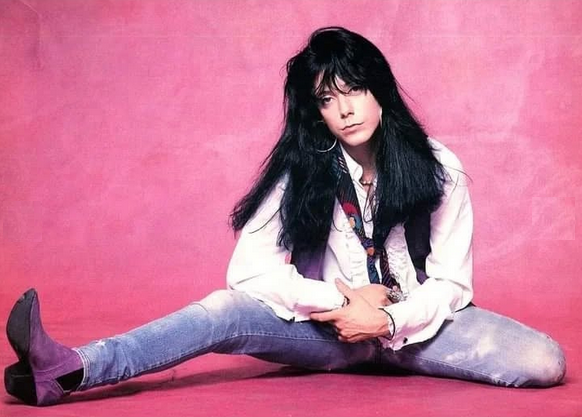
LAS VEGAS, Nevada — In a brand new interview with Metal-Rules former Faster Pussycat guitarist Brent Muscat let’s it all hang out.
The new and extensive interview covers everything from the band’s early years, to member changes, his history with other bands from the era and there is plenty of drama too boot.
Muscat was a member of the original Faster Pussycat lineup that came
Now, 40 years removed from the heyday of Hollywood, Muscat is living in Las Vegas, working at Casinos and doing some music part-time.
Muscat seems to have had a long lasting love / hate relationship with L.A. Guns frontman Phil Lewis, whom the guitarist played with in a few incarnations of various projects over the years.
Below are some excerpts from Muscat‘s interview with Metal-Rules courtesy of Marko Syrjala.
Metal-Rules: Let’s talk next about your colorful career in L.A. Guns. You first joined the band in the spring of 2000 and played with them more or less regularly until 2004 — did I get that right?
Brent Muscat: When I first joined, I was in a band with Tracii Guns, Phil Lewis, and Steve Riley. Muddy was the bass player at the time, but he was later replaced by Adam Hamilton. When Tracii quit L.A. Guns to play with Nikki Sixx’s new band, Brides of Destruction, I stayed on with L.A. Guns for about another year.
Metal-Rules: After Tracii was gone, L.A. Guns played briefly as a quartet, but soon Keri Kelli joined as a second guitarist. How did he end up joining the band?
Brent Muscat: I actually got him in the band, I think. When Tracii Guns quit, I said, “I know a really good guitar player.” I’d played on tour with Keri Kelli a bit—maybe in Adler’s Appetite with Steven Adler. I also toured with him when I was with Faster Pussycat in Europe. I think he was playing in with a band that opened for us, acts like Enuff Z’Nuff or Pretty Boy Floyd. It might have even been BulletBoys, but I don’t remember exactly which band. I just remember meeting Keri in Europe. And I knew he was a great guitar player.
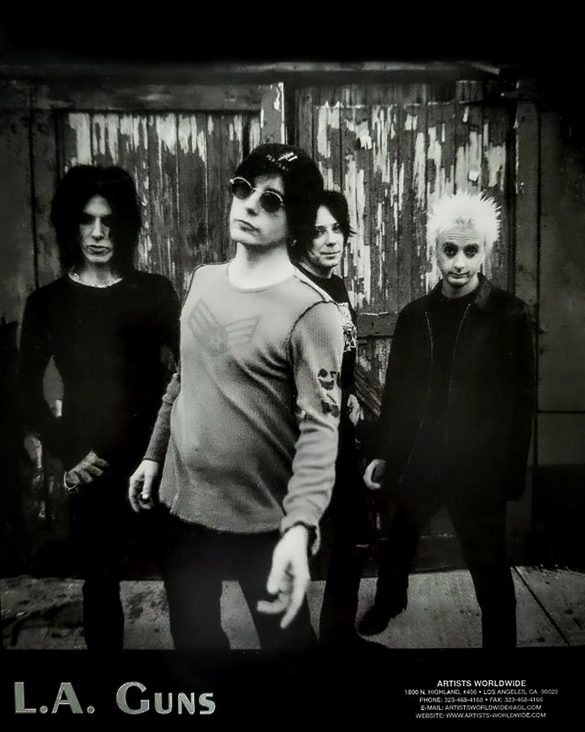
L.A. Guns 2003. Steve Riley, Phil Lewis, Brent Muscat, and Adam Hamilton
Metal-Rules: You spent many years as a member of L.A. Guns without recording any new original material. However, in 2004, the band released the covers album Rips the Covers Off, which included your performances on a couple of live tracks. What’s the story behind that release?
Brent Muscat: I was in the band right before that. Do you want to hear a funny story? I’ll tell it. I was in L.A. Guns and came back to L.A., but I was still kind of a member of Faster Pussycat, too. I had already toured with L.A. Guns, but there was still stuff I had to do with Faster Pussycat. I hadn’t quit Faster yet, and I didn’t even know they were going to tour. Phil Lewis, I think, was giving me a hard time about that—he was like, ‘You know, I want you to quit that band.’ But I just kind of said, ‘No!’ Anyway, when we came back from the tour, it started with that album. He said, ‘We’re going to make an album, and you’re going to do ten songs, and we’re going to give you…whatever.’ It would be twenty-five hundred dollars a song, so I thought, ‘Oh, that’s good.’
I said, ‘Yeah, I’ll do that.’ But the next time I saw him, he said, ‘Oh, I’m getting one of my friends to play on a song. So, you’re going to do like eight or nine songs. Oh, and it’s going to be two thousand dollars a song.’ I was like, ‘I thought it was going to be twenty-five hundred, whatever, I don’t care that much, but all right, who’s your friend?’ A week went by, and I went to his house and hung out. Then he said, ‘Oh, my other buddy is going to play on it too. So, you’re doing seven songs, and you’re getting like seven hundred fifty dollars per song.’ It kept going like that, and I started to feel a little upset. Eventually, he had three or four guys booked to play on the album. I know this because he was getting some friends to play for free, just so they could be on an L.A. Guns record. They were being really cheap—Phil and Steve Riley.
By the very end, I was down to three or four songs, and it was like five hundred dollars a song. I just went, ‘No, why bother?’ I mean, I’m not stuck up, I don’t think I’m the biggest rock star ever. But I said, ‘I’ve got name value. Why would you take me off and use guys nobody knows?’ Not that those guys were bad—they might’ve been totally fine players. But I said, ‘You have Brent Muscat, who’s been in your band and who’s played with Faster Pussycat at least. Why get these guys instead and then have me play three songs and stick me on a record with a bunch of guys nobody’s heard of?’ A couple of them have gone on to do stuff, and there’s nothing against them at all. I was just mad at Phil and Steve because they were being cheap. So, at one point, I just said, ‘No.’ He was asking me to play like three songs, and on top of that, he was trying to get me to quit Faster Pussycat.

Metal-Rules: I remember the last time Phil and L.A. Guns played in Finland, in the summer of 2016. At the time, the band featured Steve Riley, Kenny Kweens on bass, and Michael Grant on guitar. I interviewed Phil back then, and he said he would never play in the same band with Tracii again — that hell would freeze over first. But that actually happened later that same year, and the following year they released a new album with Tracii back in the lineup.
Brent Muscat: Well, see, that’s the thing about Phil—he’ll do anything for money. If the money’s right, he’ll play with Tracii even after he’s said he hated him. And if he could get better money, Tracii would be out on the street. I mean, that’s just the way Phil is. Phil will slit your throat for an extra twenty-five dollars. That’s bad, and I hate to say it, but he really is like that. And there’s a reason for it—if you go online and look at the L.A. Guns member list, it’s practically a world record. And there’s a reason for that. At one point, Phil and I were really close—we loved each other, like this—but he turned his back on me. And to this day, he still doesn’t like me. I’ve tried to talk to him, but it’s never gone anywhere.
He kind of did—if you think about Phil and me, he really did. That whole record thing was the first issue, but even after that, I was still friends with him. He didn’t take me to Japan. I took him to Japan. It was my contacts and my connections. We had a good time and did a few things, but he kept pulling little moves, like I said—slitting your throat for an extra twenty-five dollars. It would be things like this: if there was a band member who started getting popular, or getting attention, or getting girls—basically outshining Phil—he didn’t want that. Phil wanted them out of the band.
And look, I liked Steve Riley, too, God bless him. But Phil Lewis and I had a falling-out because, for 50 bucks, Phil Lewis would do anything. For 50 bucks, Phil Lewis would stab his own mother in the back. That’s just how he is. And to this day, I don’t really talk to Phil that much anymore because I feel like he’s turned into a really grouchy guy. Do you remember that guitar player? A little Japanese-Asian-looking, Filipino-looking guy.
Metal-Rules: I think you mean Michael Grant, who was fired from the band in 2018?
Brent Muscat: Yeah! He was a nice guy, really cool. Maybe he got a girlfriend; maybe Phil got jealous, and all of a sudden Phil wanted him out of the band. Or maybe Phil found another guy who would play for twenty-five dollars che
So, Phil called me one time and went, ‘Brent, would you like to play again with L.A. Guns?’ We were still kind of talking then. I hadn’t talked to Phil in forever, but at that point, we were still in touch a little bit. I wouldn’t say I was mad at him, but I’d lost a lot of respect—just seeing how he treated not only me, but other members of L.A. Guns. Still, I was willing to talk and try, you know what I mean? Because there was a time when I loved the guy. Phil and I used to be like the best friends. So, he calls me up—it was the beginning of the summer—and he goes, ‘Hey Brent, would you like a summer job or something?’ I’m like, ‘What?’ He goes, ‘Would you like to come out and play some shows with L.A. Guns?’ I go, ‘Sure. That sounds like fun. What’s going on?’
He goes, ‘Well, we just fired Michael Grant.’ And I’m like, ‘Why? He was great, you know? Of course, it was some stupid reason, but I said, ‘Hey, if you need my help, I’ll help you out.’ I wasn’t dying to do it—I was playing in Vegas full-time. Things had been going really well since I moved there, playing music and working regularly. I was actually making better money than I would’ve going out on tour with a band like L.A. Guns or even Faster Pussycat. I was doing better on my own in Vegas. So, I figured, ‘Okay, I’ll do it.’ But it wasn’t like I was desperate or anything. When he called, I was at a gig—I was actually at the airport, heading back to Vegas. I said, ‘Yeah, I’ve got some free time. I’ll help you out and come play with L.A. Guns.’ I thought it could be fun, like a summer thing.
He goes, ‘Okay, I’ll call you tomorrow or whatever.’ So, I get back to Vegas… and I don’t hear from them. Two or three days go by. I’d told a friend, ‘Hey, I might be playing with L.A. Guns again,’ and she wanted to put it online. I’m glad she didn’t, because I wanted to be sure first. I know those guys—I was cautious. A week goes by, still nothing. I start thinking he’s being rude, you know? I finally call him, and he’s talking down to me, as if he were doing me a favor, if you know what I mean. I said, ‘That’s cool—whatever it is.’ I figured we’d already made up over whatever issue we’d had, but then he trails off, saying something like, ‘Yeah, I don’t…’
A week went by without hearing from him, and I started thinking, he’s just rude—just flat-out rude. So, I said, ‘Okay, no problem.’ But then he started yelling at me about something that really wasn’t any of his business. He began talking about my wife—she’s sick, she has MS—and he was basically saying she was faking it. I was like, ‘Dude, that’s bullshit.’ And he’s yelling at me the whole time. It was just rude. That’s when I really started thinking something was wrong with him. I honestly think it’s because he’s getting older—he’s grouchy, and something just isn’t right. We had been really close, so I didn’t understand what was going on with him. Finally, I thought, whatever—I’m not dealing with this.
We got off the phone, and I just said, ‘God, man, he’s such an asshole.’ I told my wife, ‘I don’t know what’s wrong with him. Every time I try to deal with him, he just screws things up.’ What really made me mad was that I called him about a week later just to say hi, to touch base. I was even teasing him a little. I said, ‘Hey, if you kick that guy out again—’ and I was joking—‘you know, if he does something, or if he steals one of your chicks or whatever, I’m here. I’ve got my guitars ready to go. I’m back at it.’ And he goes, ‘Would you quit bothering me?’ This was like the second time I’d brought it up. He started yelling, ‘Would you quit bothering me about it? I can’t believe you’re bugging me about this. You’re pathetic.’ I said, ‘Dude, I’m just joking.’ And that’s when I thought, fuck him. That was the moment I decided I didn’t want to deal with it anymore.
According to Wikipedia, Muscat was a member of L.A. Guns in 2000 and again from 2002–2003.
It is also noted that Muscat contributed on the following L.A. Guns
releases: Rips the Covers Off (2004) and Hellraisers Ball: Caught in the Act (2004).
Read the full interview at Metal-Rules.
Stay tuned to Metal Sludge for more Breaking News, Updates and Features along with both New Interviews and Classic 20 Questions.